

Search has transformed. While you’re busy optimizing for Google rankings, AI assistants like ChatGPT, Alexa, and Google’s AI Overviews are answering user questions directly, without requiring a single click to your website. This shift has created a new challenge: being found isn’t enough anymore. You also need to be chosen as the answer.
This is where understanding AEO vs SEO becomes critical for your digital strategy. Search Engine Optimization (SEO) helps you rank in search results, while Answer Engine Optimization (AEO) ensures your content gets selected as the direct response users see. With nearly 30% of marketers reporting declines in traditional search traffic as AI systems handle more queries, mastering both approaches is no longer optional.
In this guide, we’ll break down the key differences between AEO and SEO, explain why both matter in 2026, and show you how to optimize for this new reality where traditional search and AI-powered answers coexist.
What is SEO (Search Engine Optimization)?
SEO is the practice of improving your website’s visibility on search engines like Google, Bing, and Yahoo. It focuses on making your content discoverable, relevant, and valuable so search engines rank it higher when users search for related topics.
When someone searches for “best budget smartphones 2026,” SEO ensures your comprehensive comparison article appears on the first page of results. SEO relies on factors like keyword relevance, content quality, technical performance, backlinks, and user experience.
How SEO Has Evolved
Early 2000s: SEO was primarily about keyword repetition. Websites that mentioned “cheap hotels” the most often ranked highest, regardless of actual quality.
Mid-2010s: Google’s Panda and Penguin updates shifted focus to quality content and legitimate link building. Mobile-friendliness became essential.
2026: Today’s SEO emphasizes semantic understanding, topic authority, and comprehensive content that adds genuine value beyond what already exists online. Search engines now understand context, relationships between topics, and user intent behind queries.
What is AEO (Answer Engine Optimization)?
Answer Engine Optimization (AEO) focuses on structuring your content so AI systems, voice assistants, and search features can extract and present it as a direct answer. Instead of users clicking through multiple websites, AEO aims to position your content as the authoritative source that AI tools quote or reference.
When someone asks Alexa, “How long should I boil eggs?” AEO ensures your content provides the clear, concise answer that gets spoken back: “Boil eggs for 10-12 minutes for hard-boiled, or 6-7 minutes for soft-boiled.”
The Evolution of AEO
2011-2014: Voice assistants like Siri introduced conversational queries, requiring answers formatted for speaking aloud.
2016-2022: Google’s Featured Snippets created “position zero” opportunities where direct answers appeared above traditional rankings.
2024-2026: AI-powered systems now synthesize information from multiple sources to create comprehensive answers, making structured, extractable content essential for visibility.
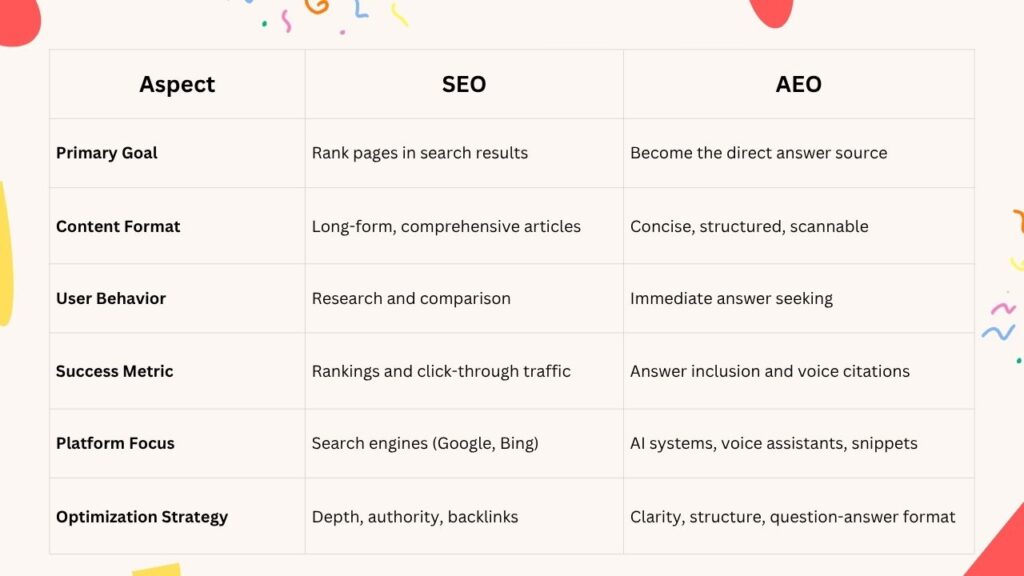
AEO vs SEO: The Critical Differences
Understanding the distinction between AEO and SEO helps you build a complete visibility strategy:
Why AEO Matters More Than Ever in 2026
The rise of AI-first search has fundamentally changed how users find information. Here’s why AEO has become critical:
Zero-Click Searches Dominate User Behavior
Users are increasingly getting their answers without visiting any website. Google’s AI Overviews, featured snippets, and voice assistants provide immediate responses, bypassing traditional search results entirely.
For example, asking “What’s the capital of France?” returns “Paris” directly, without requiring a website visit. If your content isn’t optimized for extraction, you miss this visibility entirely.
AI Systems Control Content Exposure
Around 92% of marketers now optimize for both traditional search engines and AI-powered platforms. This isn’t a trend, it’s the new baseline for digital visibility. AI determines which content gets quoted, summarized, or recommended, making machine-readable formatting essential.
Voice Search Continues Growing
With 73.7% of marketers maintaining or increasing voice search investment, conversational queries like “What’s the weather in Mumbai tomorrow morning?” require natural, spoken-style answers that AEO delivers.
How to Optimize for AEO in 2026
Successfully implementing Answer Engine Optimization requires specific techniques:
Structure Content Around Questions
Identify real questions your audience asks. Instead of broad topics like “digital marketing,” target specific queries like “How do I create a content calendar for social media?”
Lead with Clear, Direct Answers
Start every section with a concise 40-60 word answer before expanding details. This ensures both humans and AI systems immediately understand your core message.
Example: “Content marketing is a strategic approach focused on creating and distributing valuable, relevant content to attract and retain a clearly defined audience, ultimately driving profitable customer action.”
Use Natural Language for Voice Search
Write conversational answers that sound natural when spoken aloud. Avoid jargon-heavy, overly formal language that doesn’t translate well to voice responses.
Implement Structured Data
Use schema markup to help AI systems correctly interpret your content. FAQ schema, HowTo schema, and Article schema provide the context AI needs to extract accurate information.
Ensure Comprehensive Topic Coverage
Answer all aspects of a question: definitions, benefits, drawbacks, examples, and use cases. AI systems prioritize complete, authoritative responses over partial answers.
Integrating AEO and SEO for Maximum Visibility
AEO and SEO aren’t competing strategies; they’re complementary approaches that work together:
SEO Drives Discovery: Your optimized content ranks in search results, making it discoverable to users actively researching topics.
AEO Ensures Selection: Once discovered, AEO formatting ensures AI systems can extract and present your content as the authoritative answer.
Practical Integration Example
A travel website creating a Japan itinerary guide might:
- SEO: Develop an in-depth “Complete 10-Day Japan Travel Guide” with destination details, budgets, and cultural insights
- AEO: Include structured Q&A sections answering “How many days do I need in Tokyo?” with clear, extractable answers
- Result: The guide ranks well in search results (SEO) while also being quoted in AI-generated travel recommendations (AEO)
This dual approach maximises visibility across both traditional search and AI-powered answer platforms.
Common Mistakes to Avoid
Treating AEO and SEO as Separate: Both work together. Optimise content for rankings while ensuring it’s extractable for AI systems.
Ignoring Voice Search Format: Writing only for reading misses the growing voice search audience. Include conversational phrasing.
Over-Optimising for One Approach: Focusing solely on SEO rankings or only on featured snippets creates visibility gaps. Balance both strategies.
Conclusion
The question isn’t AEO vs SEO, it’s how to master both. In 2026’s AI-first search landscape, visibility depends on ranking well in traditional search results while also being selected as the authoritative answer AI systems present to users.
SEO ensures people can find your content when actively searching. AEO ensures your content becomes the answer they receive, whether through voice assistants, AI overviews, or featured snippets. Together, they create comprehensive visibility that captures audiences across all search behaviours.
Start by auditing your existing content: Is it discoverable (SEO)? Is it extractable (AEO)? By addressing both questions, you position your brand where modern search is headed and where your audience is already looking.
Frequently Asked Questions
Q1: Can I succeed with just SEO or just AEO?
No. Modern search requires both. SEO drives discovery and traffic, while AEO ensures your content gets selected as authoritative answers. Using only one approach limits your potential visibility.
Q2: How do I know if my AEO efforts are working?
Monitor metrics like featured snippet appearances, voice search citations, and zero-click search impressions in Google Search Console. Increased appearances in AI-generated summaries indicate successful AEO.
Q3: Is AEO only relevant for voice search?
No. AEO applies to all AI-powered answer systems, including Google AI Overviews, ChatGPT, featured snippets, and knowledge panels, not just voice assistants.
Q4: How long does it take to see AEO results?
Similar to SEO, AEO requires patience. Expect to see initial results within 4-8 weeks, with continued improvement over several months as AI systems recognize your content authority.
Q5: Does AEO work for all industries?
Yes, but effectiveness varies. Industries with clear factual questions (healthcare, finance, technology) often see faster AEO success than subjective fields (art, philosophy), though both benefit from structured content.
Get in touch with the United Impacts Team to discuss your content requirements.
No responses yet